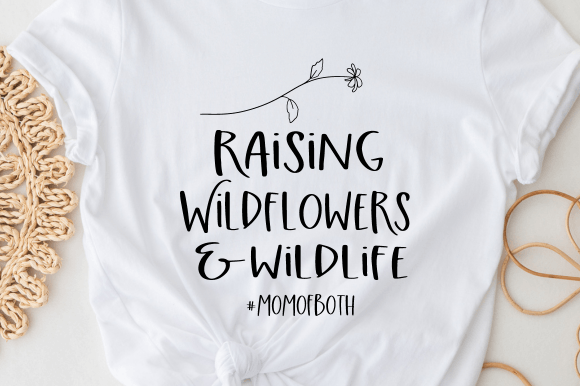
Raising Wildflowers and Wildlife SVG, Mom
As someone who’s stitched hundreds of designs for clients—from boutique baby blankets to Etsy shop merchandise—I opened Raising Wildflowers and Wildlife SVG, mom expecting charm. What I found was a quietly confident design: soft but intentional, botanical but grounded, tender without tipping into cliché. It’s not just “mom” as a label—it’s mom as steward, as quiet observer of growth and life. That mood matters deeply when you’re translating a digital file into a stitched reality.
A Tote Bag Test: Where This Design Finds Its Feet
Last week, I prepped a custom embroidered canvas tote for a local nursery owner—meant for new parents at her baby shower events. I chose Raising Wildflowers and Wildlife SVG, mom because its layout breathes: open negative space around the wildflower cluster, gentle curve of the text, and subtle wildlife accents (a tiny fox? a sparrow?) that don’t compete with legibility. On 12-oz natural canvas, it stitched cleanly at 4.5" wide—no crowding, no thread nesting. The lettering held shape without oversaturation, and the floral elements used balanced fill and satin stitch transitions—not too dense, not too sparse. Customers later told her, “It feels handmade, not mass-produced.” That’s the difference between a graphic and a well-considered embroidery file.
Where It Shines—and Where You’ll Want to Pause
Raising Wildflowers and Wildlife SVG, mom works beautifully on stable, medium-weight fabrics: cotton twill aprons, linen pillow covers, midweight sweatshirts, and structured tea towels. Its moderate detail level supports crisp results in embroidery project contexts where clarity trumps complexity—think personalized gifts for teachers, garden club members, or eco-conscious small shop products.
But here’s what I watched closely: the fine stems and delicate petals. On stretchy jersey tees or thin rayon-blend baby onesies, those details soften unless stabilized properly. I recommend cutaway stabilizer + light tear-away topping for anything under 5 oz fabric weight. And on dark fabric? Test your thread colors early—soft sage greens and warm terracottas pop best against charcoal or navy, but fade slightly on black unless you add an underlay stitch (check your machine’s capability).
Caps and curved surfaces demand extra attention. The arc of the phrase “Raising Wildflowers and Wildlife” follows a gentle radius—but if you’re stitching on a low-profile cap front, reduce width to 3.75" and confirm the hoop clears the bill’s seam. Tiny corners—like where a stem meets the “g” in “wildlife”—can snag on textured knits. A quick running-stitch outline test on scrap helps spot those before committing.
Design Integrity Meets Commercial Reality
This isn’t just a pretty T-Shirt Designs graphic—it’s a functional digital embroidery file with commercial potential. As an Etsy seller myself, I appreciate how cleanly it scales: it holds character at 3" for a baby bib and reads warmly at 5.5" on a relaxed-fit sweatshirt. That versatility means fewer variants to manage in your shop listings—and more consistent mockups across your printable mockup library.
Customer trust builds when stitching looks intentional, not rushed. With Raising Wildflowers and Wildlife SVG, mom, the balance of organic line work and readable typography signals care—not just craft, but curation. Buyers notice when lettering doesn’t blur, when petals don’t collapse into fuzzy blobs, when wildlife motifs feel integrated, not pasted on. That polish elevates your handmade product from “nice” to “worth gifting.”
Practical Notes Every Embroidery Designer Should Run Through
- Test first—on your exact fabric + stabilizer combo, not just generic cotton.
- Check stitch density—dense fill areas near flower centers may need reduced density (10–15%) on lightweight fabrics to prevent stiffness.
- Confirm hoop size—the full design fits comfortably in a 5x7 hoop, but verify your machine’s maximum stitch area before sending to the hoop.
- Inspect small details—zoom in on vector layers if editing; ensure no stray anchor points or overlapping paths that could confuse your embroidery software.
- Mock it in black and white—this reveals contrast issues fast, especially for light-on-light or dark-on-dark applications.
- Compare thread colors on light vs. dark backgrounds—what reads as “earthy” on cream may disappear on heather gray.
- Use proper stabilizer—especially for knit apparel or textured weaves like bouclé or waffle-knit towels.
- Review licensing—since this is labeled for Cricut, sublimation, and digital download use, confirm whether your intended commercial embroidery use (e.g., selling embroidered patches or wholesale apparel) falls within permitted scope.
Beyond the Stitch: Why This Fits Real Creative Businesses
I’ve seen dozens of “mom life” designs—some overly literal, some so abstract they lose warmth. Raising Wildflowers and Wildlife SVG, mom lands in the sweet spot: it invites interpretation without demanding explanation. That makes it ideal for small shop product lines where brand voice leans gentle, nature-connected, and unhurried. It pairs naturally with earth-toned packaging, kraft tags, and minimalist photography—no forced styling needed.
For craft business owners building seasonal collections, it bridges spring and early summer effortlessly—think Mother’s Day bundles, baby shower favors, or garden party merch. And because it avoids dated trends (no glitter fonts, no overused icons), it stays fresh across multiple holiday cycles and customer cohorts.
As a designer, I value assets that support both speed and soul. This Graphics file delivers: clean vector structure for easy resizing, thoughtful spacing for real-world hooping, and emotional resonance that translates directly into buyer engagement. It won’t wow with flash—but it earns repeat orders, heartfelt thank-you notes, and quiet confidence in your next finished product.