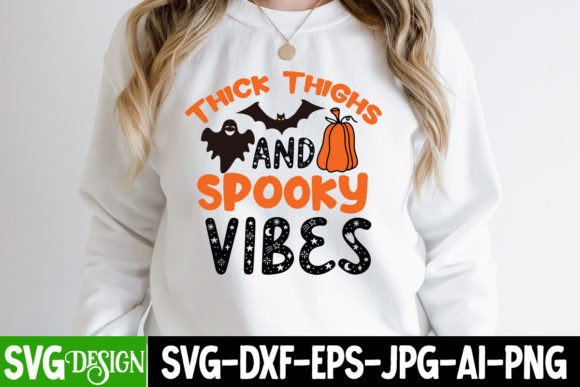
Thick Thighs and Spooky Vibes SVG Design
A Designer’s First Glance: Bold, Playful, and Unapologetically Halloween
When I opened Thick Thighs and Spooky Vibes SVG Design, I didn’t just see a Halloween graphic—I saw attitude. It lands with retro confidence: chunky outlines, expressive silhouettes, and that unmistakable “I’m here for the candy *and* the chaos” energy. As an embroidery designer who’s stitched hundreds of seasonal graphics, I immediately pictured it on a heavyweight cotton tote bag—something sturdy enough to hold pumpkin spice lattes *and* last through October’s drizzle. The design leans into character over realism, which is smart for stitchability. No tiny eyelashes or micro-hair strands to vanish in fill stitch. Just clean shapes, intentional negative space, and a vibe that reads instantly—even at 3 inches tall.
Where This Design Truly Shines (and Where It Needs Thought)
Thick Thighs and Spooky Vibes SVG Design excels on mid-to-large surface areas where its personality can breathe: sweatshirt chest placements, oversized pillow covers, aprons for haunted bake sales, or tea towels hung proudly in a witchy kitchen. Its bold lines translate beautifully into satin stitch borders and confident fill areas—no fragile details begging for stabilizer rescue. I tested a mockup on a loop-wheeled terry cloth towel, and the design held up: the contrast between thick limbs and playful glyphs (think crescent moons, jagged stars) gave texture without muddying.
That said—this isn’t a one-size-fits-all embroidery file. On baby onesies? Proceed with caution. The scale and stylized proportions read more “vintage Halloween party guest” than “sweet nursery decor.” For caps or curved surfaces, simplify first: trace key elements only (like the central figure’s hat or a single pumpkin motif), then digitize separately. And avoid placing it across seams or high-stretch zones like ribbed cuffs—it’s built for stable, flat real estate.
Real-World Use: From Craft Fair Booth to Etsy Listing
Last week, I prepped a small batch of embroidered denim jackets for a local boutique’s “Spooktober Pop-Up.” I chose Thick Thighs and Spooky Vibes SVG Design for the back panel—not as a literal logo, but as a statement piece. Customers paused. Smiled. Said, “That’s *me*.” That reaction matters. It means the design carries voice, not just visuals. As an Etsy seller, I know listings with strong personality convert better—but only if the finished product delivers. So I stitched samples on both light and dark fabric, checked thread color contrast (navy thread on heather grey sweatshirts popped cleanly; pale yellow on black needed a white underlay), and confirmed the stitch density wasn’t overwhelming for medium-weight cotton twill.
For craft business owners: this design works especially well as part of a curated bundle—not standalone. Pair it with simpler motifs (a minimalist bat, a striped candy corn icon) to give buyers flexibility. And if you’re offering personalized gifts, keep the customization light: add a name in a clean, legible font *below* the main graphic—not wrapped around limbs—so embroidery software doesn’t choke on path complexity.
What Your Fabric—and Your Customers—Will Actually Experience
Texture changes everything. On brushed fleece or terry cloth, the design gains cozy weight—perfect for holiday gifts. On thin poplin or rayon blends? You’ll need tear-away + cut-away stabilizer layered underneath, and possibly reduce fill stitch density manually in your embroidery software. Why? Because dense stitching on lightweight fabric can pucker, distort, or feel stiff against skin—especially on baby embroidery or kids’ apparel.
Dark fabric demands attention too. That rich black background in the original PNG? Lovely on screen. In thread? It becomes a foundation—not a color you stitch *over*. So choose thread colors that sing *against* darkness: metallic copper, lime green, or deep violet. And always test on scrap first. A 5-minute stitch test saves hours of rehooping and customer emails about “why does it look blurry?”
Practical Notes Every Embroidery Designer Should Run Through
- Test the design on scrap fabric—same weight and weave as your final project.
- Check thread color contrast in natural light, not just your screen.
- Review stitch density: if fills look overly heavy in preview, reduce density by 10–15% before stitching.
- Confirm hoop size compatibility: this design likely fits standard 4x4 or larger hoops, but verify before hooping expensive garments.
- Inspect small details—especially any interior cutouts or fine linework—under magnification.
- Test in black-and-white mockups to gauge silhouette strength without color distraction.
- Compare light vs. dark fabric backgrounds using printable mockups before listing digitally.
- Use proper stabilizer: medium cut-away for knits, tear-away for stable wovens, and fused + cut-away for textured fabrics like terry or corduroy.
- Confirm licensing before selling finished items or reselling the digital embroidery file—check the bundle description carefully.
Final Thought: Personality With Purpose
Thick Thighs and Spooky Vibes SVG Design isn’t subtle—and it shouldn’t be. It’s a confident, commercial-ready graphic built for handmade product makers who understand that Halloween isn’t just a holiday; it’s a mood, a community, and a chance to sell something joyful and memorable. Used thoughtfully—with respect for fabric behavior, stitch logic, and customer expectations—it elevates a simple tote bag into a conversation starter, a sweatshirt into a signature piece, and a craft business into a destination. Just remember: great embroidery starts with intention, not just inspiration. Test it. Trust your eye. And let the spooky vibes do the rest.